Fraunhofer Sends Spiders to the Rescue


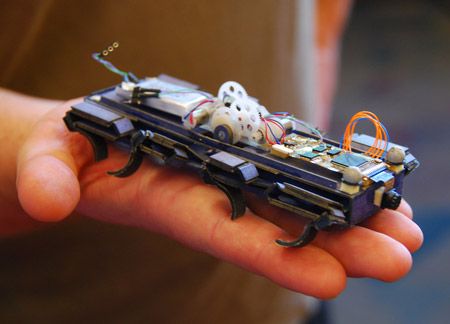
Hightech-Spider for dangerous tasks

20 cm long legs and elasic bellows for the joints support the high-tech robot spider built by the Fraunhofer IPA. Picture: Fraunhofer

Silicon.de recently reported on a new robot for hazardous missions: The high-tech spider developed by the Fraunhofer Institute for Manufacturing Engineering and Automation IPA in Stuttgart (Germany). The spider is built using a 3-D printing technique and is extremely lightweight. The Fraunhofer IPA reports in its research news: Continue reading

Posted in New and Noteworthy, Unusual | Tagged , , , , | Leave a comment

QR Codes (Updated): From Urinals And Bus Stops to National Parks to Art, Shopping and Tombstones


QR code above urinal

QR code above urinal at the Volta exhibition during the Armory Art Show March 2011 (Picture taken by the author. Click to enlarge)

We can observe more and more adoption of QR codes and their pervasiveness. In Asia you find these codes anywhere in the meantime and they allow quick responses usually by use of a smart phone’s QR reader.

I have seen them above urinals (in the mens’ room at the Volta Exhibit during the Armory Art Show in NYC last March, see right–the codel leads to a web page from collectors for collectors) as well as on city walls, in art and many other places.

In Florida there is now a bus line where you can get the schedule by pointing your smart phone to a plaque at the bus stop.

But this report is hinting to a novel use for QR codes: QR Code on Tombstone Creates Dynamic Memorial.

Here the picture of the QR code enhanced tombstone in Israel:

QR Code on Tombstone

Tombstone with a message. The message points to a memorial website. (Image as it appears in the article)

QR code

QR code from picture above

On the right is the code from the picture above:

Continue reading

Posted in Identity Management, New and Noteworthy, Social Media, Unusual, Web | Tagged , , , , , , | 2 Comments

New EU Directive Might Reshape the Clouds


Viviane Reding

Viviane Reding, European Commissioner for Justice, Fundamental Rights and Citizenship will strengthen consumer rights and protection in the cloud . (Image at http://www.experian.it)

As reported in Silicon.de, in Experian.it and in other sources, the European Commission is planning to release a new directive on data protection, which will affect the Cloud Computing industry. Viviane Reding, European Commissioner for Justice, Fundamental Rights and Citizenships is planning to update the Data Protection Directive. The Data Protection Directive was first introduced in 1995, and a lot of new challenges for personal Data Protection have appeared, from social networks to cloud computing and the current digitalization of public data assets.

Experian reports: The process to update the Directive has just started. Over 160 responses were collected to a public consultation that lasted until December 2009. These responses were crafted by citizens, businesses and other organizations and public authorities. The objective of this public consultation is to gather “views on the new challenges for personal data protection, in particular in the light of new technologies and globalisation”, and what steps should be taken to overcome those challenges. Now Reding plans to present a first draft of the legislation by autumn this year.

In her speech in January she outlined the main issues to be covered in the updated directive (quoted from Experian): Continue reading

Posted in Cloud Computing, Internet, Security, Social Media, Web | Tagged , , , | 2 Comments

Star Trek’s ‘Tricorder’ Device Coming Soon?


Medical Tricorder

Mobile phones as doctors? This vision will be tested, starting in a few months. Photo Credit: X-Prize Foundation. From the article quoted.

Star Trek’s Dr. “Bones” McCoy made no bones about the state of 20th Century medicine — invasive, primitive, “Dark Ages,” were a few of his pejorative terms for modern medicine. In the 23rd century, Bones and other starship crew members used hand-held devices called “tricorders” that instantaneously diagnosed people’s injuries or sicknesses — and healed them as well. “It’s a wonder anyone made it out of the 20th century alive,” he once sniffed. 

Early next year, the X Prize Foundation — noted for competitions to in private space travel and moon probes — announced it will be launching a $10-million-prize competition to any team that can design the first functioning tricorder, that “will enable consumers in any location to quickly and effectively assess health conditions, determine if they need professional help and answer the question, ‘What do I do next?’” Quotes from the first article cited below. Continue reading

Posted in e-Health, New and Noteworthy | Tagged , , , , | 1 Comment

OSBF: Opening Clouds


Image representing Open Source Business Founda...

Image via CrunchBase

The Open Source Business Foundation e.V., the European network for the Open Source Industry, just launched an “Open Cloud Business Initiative” (OCBI). The goal of the OCBI is to promote the principle of openness, which is responsible for the success of the Open Source Software movement, in the area of the cloud: the future lies in the Open Cloud – especially in a business context.

The Open Source Business Foundation eV (OSBF) lays out the following six principles under their “Open Cloud Future Initiative”: Continue reading

Posted in Cloud Computing, Open Systems | Tagged , , , , | 1 Comment

New Security Threat: Infected QR Codes


Security Threat QR Code

This QR Code says: "Go to website" and is harmless. But it could contain dangerous instructions to the phone. Picture from article quoted.

Tod Wasserman recently warned on “Mashable Tech”:

“Be careful the next time you scan a QR code, because it might just cost you money and wreak havoc on your smartphone.

“That’s the warning from Kaspersky Lab, which has noticed the first instance of QR code tampering. The incident took place in Russia last month and hoodwinked consumers who thought they were downloading an Android app called Jimm. The code actually contained malware that sent SMS codes to a premium rate number that charged for each message.”

Read the original post here: New Security Threat: Infected QR Codes.

So — as an extra precaution use your QR Code Reader’s “Edit” or “Display” function before you embark on an adventure with unknown outcome . . .

BTW the QR Codes displayed on my “About” page on this blog only contain my contact data and no 900-Number SMS malware.

Posted in Internet, New and Noteworthy, Security | Tagged , , | 1 Comment

Are you clueless when it comes to integrating social into your website?


Clueless (film)

Image via Wikipedia

A recent non-scientific poll done by Jeremy Victor, which he published on SmartBlog is titled “Are you clueless when it comes to integrating social into your website?.”

He reports as results:

  • 42.86%: “Our website has “Follow/Fan Us” links to our social presences but with no strategy”
  • 22.08%: “There is no integration between our website and our social presence”
  • 18.18%: “Our website is a fully integrated component of our social activity, with the goal being to bring users from the social site”
  • 12.99%: “Our website displays activity from our social presence and has Follow/Fan Us links”
  • 3.90%: “Our website has “Follow/Fan Us” links that encourage users to promote our brand after following”
He concludes that: Continue reading
Posted in Management, Social Media | Tagged , , , , | Leave a comment

Wireless Health Care


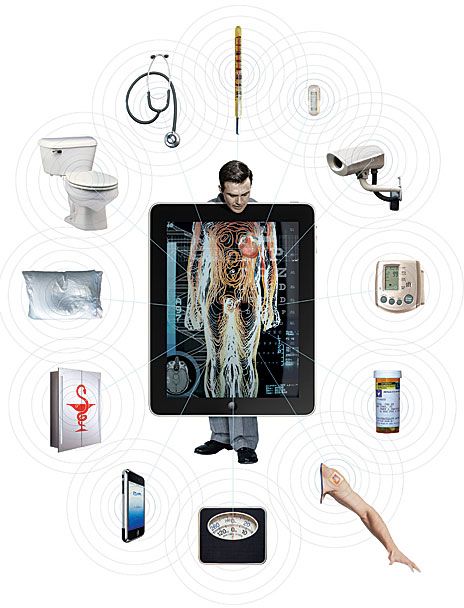
Wireless Health Care

Monitoring Your Health -- image from the quoted article

Just read a very interesting article on “ambient health monitoring”. Joseph M. Smith wrote in IEEE Spectrum an article on Wireless Health Care. Here a few passages from the article:

“Imagine a world in which your medicine cabinet notices that you are due for a prescription refill and calls it in. A sensor implanted under your skin detects a fluid buildup in your lungs and alerts your doctor, who decides your heart medication needs an adjustment and contacts the pharmacist to change your dosage.

Continue reading

Posted in e-Health, New and Noteworthy | Tagged , , , | 2 Comments

’10-Cent Medical Checkup’ Using Cell Phones?


Medical devices to connect to phones

Low-cost medical device prototypes are designed for use with cell phones. Image: Caltech; from the article quoted

Caltech runs a Summer Undergraduate Research Fellowship (SURF) program where students work on special projects. As part of a cell phone medicine project, the students have spent their summer developing and fine-tuning prototypes that could someday enable a 10-cent medical checkup for developing or remote regions.

Continue reading

Posted in e-Health, New and Noteworthy | Tagged , , , | 1 Comment

New Human-Computer Interface: Stick-On Electronic Tattoos


Electronic Tattoo

Pinch me: These microelectronics are able to wrinkle, bend, and twist along with skin, even as it is being pinched, without breaking or coming loose. John A. Rogers, University of Illinois (picture at technologyreview.com)

Technology makes interesting inroads in medicine. Not only in electronic patient records and e-prescription but also in connecting patients to instrumentation and in tele-monitoring.

“Researchers have made stretchable, ultrathin electronics that cling to skin like a temporary tattoo and can measure electrical activity from the body. These electronic tattoos could allow doctors to diagnose and monitor conditions like heart arrhythmia or sleep disorders non-invasively. Continue reading

Posted in e-Health, New and Noteworthy | Leave a comment

Gartner: Difficult Times For the CIO


Gene Hall

Gene Hall as pictured on research-live.com

Silicon.de reported on the Gartner Symposium/ITxpo 2011 in Orlando:

Gartners CEO Gene Hall warned the CIO’s of the four winds that blow at the CIO simultaneously. CIO’s will have to bundle up to weather the coming storm.

The four winds Hall talked about are four new disruptive technologies, which will change profoundly the IT landscape and the life of CIO’s. These are:

  1. Social Media — with 1.8 bio users (20% of world population) it is out of its infancy. High time that CIO’s look into integrating this into their enterprise IT infrastructure
  2. Mobility — the explosive dissemination of iPhones, iPads, Android devices sends a clear signal. “Bring your own device” is becoming rather the rule than the exception. Customers and partners will access your systems more and more on these mobile devices. The development of apps for the mobile devices will be a factor of four above the development for desktop systems
  3. Cloud Computing — not yet mainstream but with the mega players starting their offerings as cloud services this technology will prevail. Cloud computing is the industrialisation of IT.
  4. New Analytics — the data warehouse is dead, long live the diverse content management systems with their searchability. Continue reading
Posted in Cloud Computing, Management, Social Media | Tagged , , , , , , | Leave a comment

“You Have Zero Privacy Anyway — Get Over It” (Really?)


privacy

Is privacy being erased everywhere? Image by alancleaver_2000 via Flickr

Scott McNeally has been quoted many times with this (in)famous phrase from 1999.

But as Steven Cherry discusses is his podcast (mp3) The Car as Informant – IEEE Spectrum “even he (Scott) would be surprised at the extent to which we can now be tracked, both online and in real life.

“The car navigation and emergency response service OnStar, revealed that it was tracking cars even after their owners cancel their subscriptions—recording where you drive and stop for gas, the diagnostics that the car itself collects, and the speed, direction, and other information generated at the time of an accident.

“You can opt out of OnStar, or even have its sensors removed, but nowadays law enforcement officials can put tracking devices on your car without your knowing about it.

“If that sounds like it might be a violation of the U.S. Constitution’s fourth amendment protection against unreasonable searches, you’re not alone. That very question will be raised in a court case slated for argument at the U.S. Supreme Court in November.”

Continue reading

Posted in e-Health, Identity Management, Internet, Security, Social Media | Tagged , , , , | 4 Comments

Can We Trust Open Source Software?


Vieri del Bianco, Luigi Lavazza, Sandro Morasca, and Davide Taibi published a survey on Open Software Trustworthiness.

Conceptual Map of the FLOSS (Free/Libre Open S...

Image via Wikipedia

Computing Now | October 2011 | What’s New | A Survey on Open Source Software Trustworthiness.

They write:

“Over the past few years, users in many sectors have increasingly adapted open source software (OSS) products. No longer the product of lone coders, industrial-strength OSS is often developed by organized communities and sometimes even by major software companies applying the same rigorous processes and high-quality standards they use when developing their commercial products. However, many software companies and users alike are still somewhat reluctant to massively adopt OSS in their mainstream activities, primarily because they’re unsure if and to what extent they can actually trust OSS. Trust must be built, and, as with any offering, OSS products would probably be more easily trusted when their claims are backed by reliable evidence.”

READ FULL ARTICLE (pdf)

Having been for 13 years one of the public spokespersons of Sun Microsystems, the company that contributed most code to the Open Source Community in the industry,  I gave hundreds of presentations at conferences and at customer sites on “Open Source–Open Systems–Open Standards” (you can look at an example presentation here) and I still believe that this is a powerful and more sustainable model for software creation.

Do you think that the people surveyed were overly optimistic? Overly pessimistic?

Or should we ask: Can we trust closed systems and proprietary software?

Posted in Open Systems | Tagged , , | Leave a comment

Swiss ICT Award: And the Winners Are . . .


On October 18th 2011 the Swiss ICT Award ceremony took place at the Swiss ICT Forum in the KKL in Lucerne.

Lake Lucerne

Lake Lucerne, the location of the Swiss ICT Award. Photo taken by the author just before the event in front of the building

Continue reading

Posted in New and Noteworthy | Tagged , | Leave a comment

Greatest Threats to Cloud Security


Evening Cloud over Podgirica

Evening Cloud over Podgorica, Montenegro (photo taken by the author)

Experts explain greatest threats to cloud security. (NetworkWorld)

The article starts:

Cloud security threats come in all shapes and sizes, so we asked eight experts to weigh in on what they see as the top threat to cloud security. The answers run the gamut, but in all cases, our cloud security panelists believe that these threats can be addressed.

It covers the following issues (written by named expert) Continue reading

Posted in Cloud Computing, Internet, Security | Tagged , | 3 Comments

Daddy, Is this iPad Broken? (Baby Handling a Magazine)


Recently I discussed Digital Recluses, Digital Immigrants and Digital Natives (see picture below) in a blog. But what is shown in this video makes a new category necessary. Maybe “Digital Thoroughbreds?”

Continue reading

Posted in New and Noteworthy, Social Media, Unusual | Tagged , , , | 1 Comment

The Six Best Free Facebook Apps For Businesses


Music while you walk

Tweeting means business--not only for birds (Image by Steve-h via Flickr)

Jesse Stanchak published a blog on The 6 best free Facebook apps for businesses.

He mentions some of the better free applications out there. Quoted from the posting:

“Note — I’ve purposely left out custom development apps, e-commerce apps and coupon/contest apps. Those will have to wait for their own posts. Continue reading

Posted in Social Media | Tagged , , , , , | 3 Comments

Scott McNealy’s Startup “Wayin”: Social Media For Super-Fans


Scott McNeally

Scott McNealy's Twitter profile photo. (Credit: Twitter.com)

The former CEO and co-founder of Sun Microsystems Inc. (now part of: http://www.oracle.com) is the creator of a new startup. It provides a new social media service called Wayin. The service launched on October 5th and is a application in the realm of opinion polls.

Users of the network can vote on polls but also can easily create their own polls. Polls present themselves as an image with the questions superimposed (see example at right). Polls will mostly be on current shows in Sports and TV but also on other issues.
Continue reading

Posted in New and Noteworthy, Social Media | Tagged , , , , | Leave a comment

Robot Birds and Octoroaches On The Loose at UC Berkeley


Octoroach

Octoroach---image from the article quoted

As mentioned in an earlier blog (Quadrotors Can Now Play Catch, All-Robot Baseball Team Closer to Reality) I have a weakness for flying robots and having studied insects for a considerable time during my research years I find the objects mentioned here fascinating. The following are quotes from the article.

Continue reading

Posted in New and Noteworthy, Unusual | Tagged , , , | Leave a comment

A Network for Wild Experimentation — 100 Gbit/s


A Network for Wild Experimentation – Technology Review.

Dark Fiber network in the US

Dark fibers: Researchers will use dormant networking resources—which extend through the areas indicated on this map—to perform a variety of experiments. ESNet (image and caption from the quoted article)

Quote from the article: ESNet and Internet2 have built a networking test bed for ideas that are too disruptive for the networks that people actually use.

“In a few unused back alleys of the Internet, researchers are testing radical new ways of transferring information, often at speeds almost unimaginable to the home Internet user.

Internet2, a consortium devoted to developing advanced networking applications and technologies, and the Energy Sciences Network (ESNet), which provides powerful data connections for scientists at national laboratories, universities, and research institutes, are putting together experimental networks on top of dormant networking resources known as “dark fiber.” While the researchers say it will be years before the advances reach individuals and businesses, they think the work will ultimately ensure that the Internet functions smoothly in the future. For example, the experimental networks could allow researchers to update protocols, anticipate security needs, try out better hardware, and look at ways of making networks more energy-efficient.”

Read the full article.
Continue reading

Posted in Internet, New and Noteworthy, Web | Tagged , , , | Leave a comment